 by
by 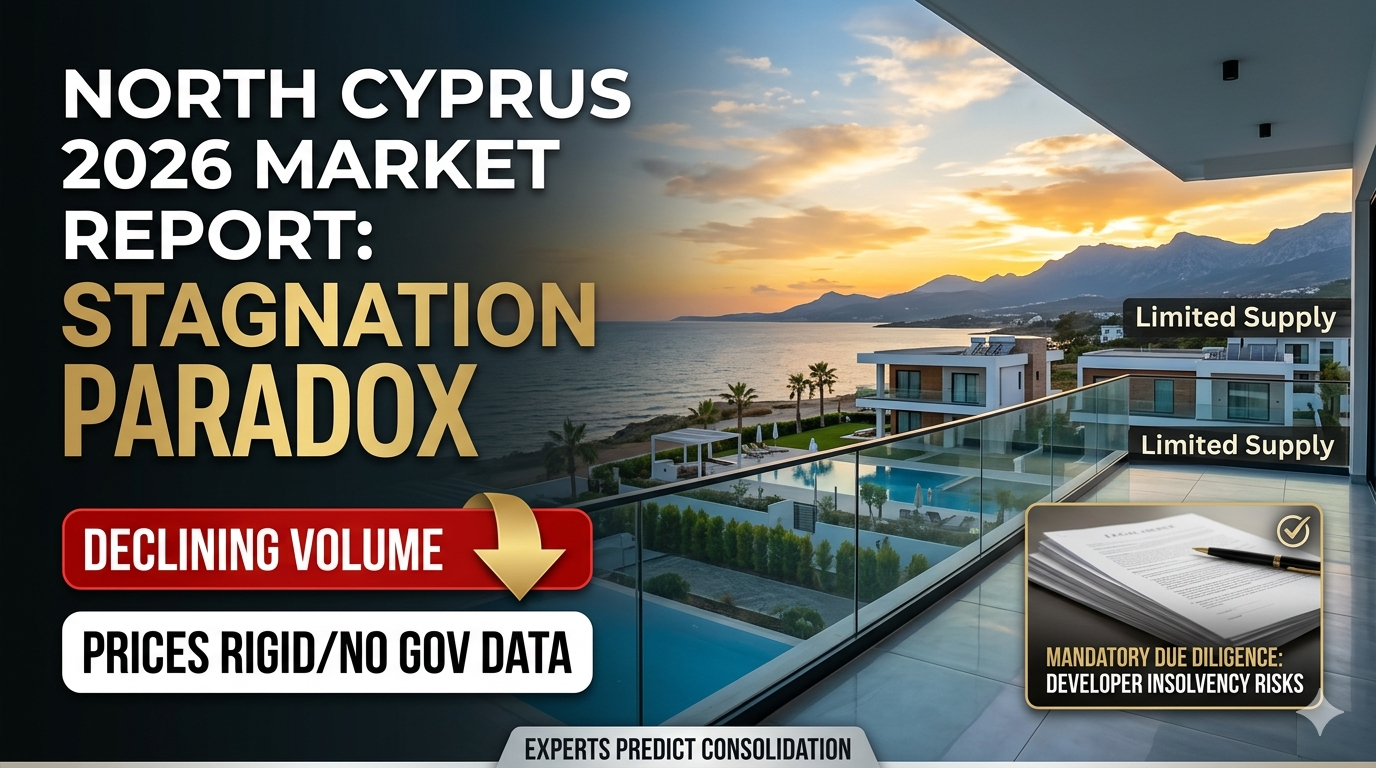
2026 North Cyprus Real Estate Market Review: The Stagnation Paradox
The North Cyprus (TRNC) real estate sector has entered 2026 in a state of high-altitude stagnation. For investors and homeowners, the current landscape is a paradox: transaction volumes are down and foreign buyer interest has cooled, yet property prices remain stubbornly high. This comprehensive review breaks down the “Invisible Decline,” the impact of recent legislative shifts, and why the secondary market is currently the only place for true price discovery.
1. The Data Transparency Crisis
The first reality any professional must acknowledge is the total absence of open, government-provided data. Unlike the Republic of Cyprus (South), which offers a transparent land registry portal, the TRNC operates in a data vacuum. There is no official public record of sales volumes, median price-per-square-meter changes, or historical transaction counts. In 2026, market intelligence is derived solely from agency sentiment and Land Registry filing delays. This lack of transparency has allowed a “gray market” to persist, where official price lists often diverge significantly from actual closing prices.
2. The Impact of the “New Law” (19/2025)
The legislative landscape of 2024 and 2025 fundamentally altered the market’s trajectory. Following the implementation of Yasa Gücünde Kararname No. 19/2025, the initial shock of restricted ownership has settled into a permanent dampening of demand.
-
Foreign Buyer Decline: Increased Transfer of Title taxes (up to 12% upfront) have acted as a significant barrier.
-
Regional Caps: The 7% regional ownership limit for foreigners in areas like Iskele and Esentepe has effectively hit a “ceiling.”
-
The Local Squeeze: Local buyers are increasingly priced out due to high inflation and the reliance on British Pound (GBP) pricing in a Lira-dominated economy.
3. The Iran Issue and the Search for “Safe Havens”
A significant driver of the current market volatility has been the massive shift in the Iranian investor demographic. Following the aggressive “dumping” phase of 2025, where Iranian owners liquidated assets to exit the market, the sector is now looking for a new catalyst. Local real estate agents are increasingly pivoting their focus toward the Middle East, specifically hoping to capture capital flight from the ongoing Dubai and regional conflicts.
There is a strategic push to market North Cyprus as a “Plan B” or a secondary safe haven for investors who feel over-exposed in the UAE or are seeking more affordable, non-aligned jurisdictions. While agents hope to attract Dubai-based investors, the reality of the TRNC’s banking isolation and the complexities of international money transfers remain a significant friction point.
4. The Lifestyle Anchor: A Sanctuary for Retirees
Despite the complex investment climate, North Cyprus continues to exert a powerful pull on those seeking a peaceful, high-quality retirement. Beyond the spreadsheets and tax laws, the island remains one of the few Mediterranean destinations where a quiet, safe, and affordable lifestyle is still accessible. For many European and international retirees, the TRNC is not a speculative play but a deliberate choice for a “new home” defined by 300 days of sunshine, low crime, and a slower pace of life.
This demographic is less concerned with “flipping” properties and more focused on long-term residency. The simplicity of the residency process for those over 60, combined with the lack of tax on foreign pensions and significantly lower healthcare costs, ensures that the “Retirement Sector” remains the most stable pillar of the market. While investors chase ROI, retirees are chasing peace, and it is this consistent demand that is preventing a total collapse in the villa and high-end apartment segments.
5. Why Prices Won’t Drop: The Supply Side
Logic suggests that when demand falls, prices follow. However, North Cyprus in 2026 is bucking this trend due to Replacement Cost Theory. Developers are facing a 20% year-on-year increase in construction costs, driven by rising global material prices and local labor shortages. A developer cannot lower their price list by 30% if the cost to build that same unit has increased. Consequently, we are seeing a “frozen” primary market where developers hold the line to avoid selling at a loss.
6. The Development Freeze & Land Scarcity
A defining characteristic of 2026 is the absence of new project launches. The tap has been turned off compared to the 2022-2023 boom.
-
Investor Flight: Pre-launch “bulk” investors have moved to more stable or transparent markets.
-
Focus on Completion: Reputable developers have pivoted to finishing existing phases to unlock final installments.
-
The “Zombie” Risk: Smaller developers with no new cash flow are at high risk of insolvency.
-
Land Scarcity: North Cyprus has a limited supply of “clean” development plots with verified Title Deeds. Local landowners are currently choosing to wait rather than sell at a discount, which prevents an oversupply from further diluting the market.
7. Conclusion: A Year of Consolidation
The North Cyprus real estate market is maturing through a painful consolidation phase. 2026 is a year for the professional investor—one who understands that limited land and high construction costs provide a floor for prices, but legislative uncertainty has removed the ceiling for rapid growth. For those with cash and a 5-year horizon, the lack of new competition means that completed, high-quality units with individual deeds will eventually become extremely scarce.
Would you like me to identify the best “Quiet & Peaceful” regions in the North specifically for a retirement-focused SEO campaign?