 by
by 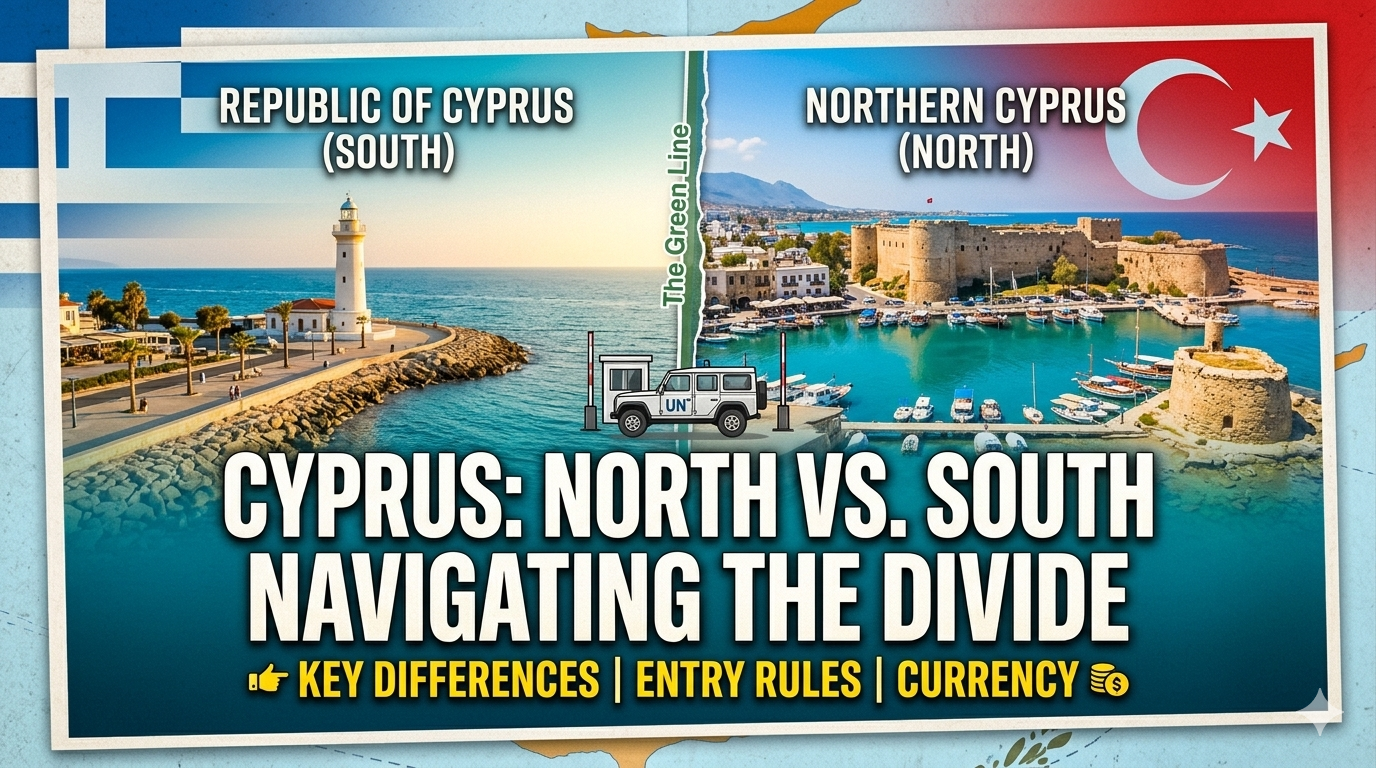
The Ultimate Guide to Cyprus: Navigating the North and South in 2026
Cyprus is far more than just a sun-drenched Mediterranean destination; it is a complex, beautiful island defined by a unique “two-world” reality. For travelers, investors, and expats, understanding the nuances between the Republic of Cyprus (South) and the Turkish Republic of Northern Cyprus (North) is essential for a seamless experience.
This comprehensive guide breaks down the political, economic, and cultural landscapes of both sides to help you navigate this multifaceted island.
1. Political and Administrative Landscape: A Tale of Two Entities
The defining characteristic of Cyprus is its division, maintained by a UN-patrolled Green Line. While the island is geographically one, it functions under two distinct administrative frameworks.
The Republic of Cyprus (South)
The South is an internationally recognized state and a member of the European Union. It operates under a legal system aligned with EU standards, offering a standardized European experience. This recognition makes it the primary choice for those seeking the security of EU citizenship and regulatory oversight.
The Turkish Republic of Northern Cyprus (North)
The North operates as a de-facto state. While Türkiye is currently the only nation providing formal diplomatic recognition, the North functions with its own fully established government, police force, and legal system. Interestingly, major global powers like the United States, United Kingdom, and Australia maintain representative offices in North Nicosia to facilitate local relations and assist their citizens.
2. Economic Comparison: Currencies, Banking, and Real Estate
The economic divide is perhaps where the differences between the North and South are most tangible for the average visitor or investor.
Currency and Everyday Transactions
| Feature | Southern Cyprus | Northern Cyprus |
| Primary Currency | Euro (€) | Turkish Lira (₺) |
| Alternative Currencies | Rarely used in daily trade | GBP (£), Euro (€), and USD ($) are widely accepted |
| Inflation Sensitivity | Low (Tied to Eurozone) | Higher (Tied to Turkish Lira) |
In the North, the flexibility of using British Pounds or Euros in shops and for real estate transactions offers a unique layer of financial convenience that you won’t find in the South.
Banking Backbone
The South is integrated into the European Central Bank (SEPA) network, making it a standard hub for European banking. Conversely, the North utilizes the Turkish Banking Regulation and Supervision Agency (BRSA). Despite being outside the Eurozone, the North boasts a robust electronic banking infrastructure, allowing for international transfers through Turkish branches—a vital tool for the growing expat community.
Real Estate Opportunities
-
The South: Offers a high-demand, EU-regulated market. Prices are generally higher, reflecting its status within the European Union.
-
The North: This is a rapidly growing market. It has become a hotspot for British, Russian, and Turkish investors due to more competitive entry prices and the unique charm of its coastline.
3. Travel and Entry Logistics: Crossing the Green Line
Navigating entry points is the most critical logistical hurdle for visitors. Understanding the “legality” of entry points from the perspective of both administrations is key.
Ercan International Airport (ECN)
Located in the North, Ercan is the primary gateway for those heading to Kyrenia or North Nicosia. Currently, all flights must touch down in Türkiye before proceeding. While it is a fully operational international port of entry for the North, the Republic of Cyprus (South) considers it an “unauthorized” port.
The “Crossing” Reality
If you enter the island via Ercan, you may face challenges if you attempt to cross the Green Line into the South. Travelers of certain nationalities might be denied entry to the South if their passport shows an entry stamp from Ercan. To avoid this, many travelers enter through Larnaca or Paphos in the South and then drive across the border checkpoints to the North.
4. Culture and Lifestyle: Mediterranean Roots, Different Flavors
While both sides share the same turquoise waters and rugged mountains, the “flavor” of daily life varies significantly.
The North: Tradition and Leisure
The North is often described as feeling more relaxed and “authentically” Mediterranean. Life moves at a slower pace, particularly in the mountain villages.
-
Key Hubs: Kyrenia (Girne) is famous for its historic harbor and luxury hotels, while North Nicosia serves as a sophisticated center for commerce and education.
-
Vibe: A blend of Turkish hospitality and traditional Cypriot culture, featuring world-class golf courses and a thriving university scene.
The South: Standardized Sophistication
The South reflects a more standardized European lifestyle. You will find large international retail chains, high-end shopping malls, and a heavy emphasis on Greek cultural heritage and festivals. It feels more “metropolitan” and faster-paced than its northern neighbor.
5. Infrastructure and Urban Development
The North has seen a massive surge in infrastructure investment over the last decade. Modern luxury hotels and casinos have turned the North into a “Las Vegas of the Mediterranean,” attracting high-volume tourism. The universities in the North also attract thousands of international students, creating a vibrant, multicultural atmosphere in cities like Famagusta and Nicosia.
In contrast, the South’s infrastructure is heavily subsidized by EU development funds, resulting in high-quality highways and public services that mirror what you would expect in mainland Greece or Italy.
Summary: Which Side is Right for You?
The North and South function as two separate entities with their own laws, economies, and identities.
-
Choose the South if you prioritize EU regulation, direct international flights from Europe, and a standardized Western lifestyle.
-
Choose the North if you are looking for a more relaxed pace, unique investment opportunities in real estate, or a blend of cultures that feels “removed” from the standard European track.
Despite the political complexities, the island remains one of the safest and most beautiful locations in the world. Whether you are sipping coffee in a quiet village in the Kyrenia mountains or enjoying the nightlife in Limassol, Cyprus offers an experience unlike any other.




